

SubLedger vs. SubBuddy: Which Privacy-First Subscription Tracker Actually Does More?
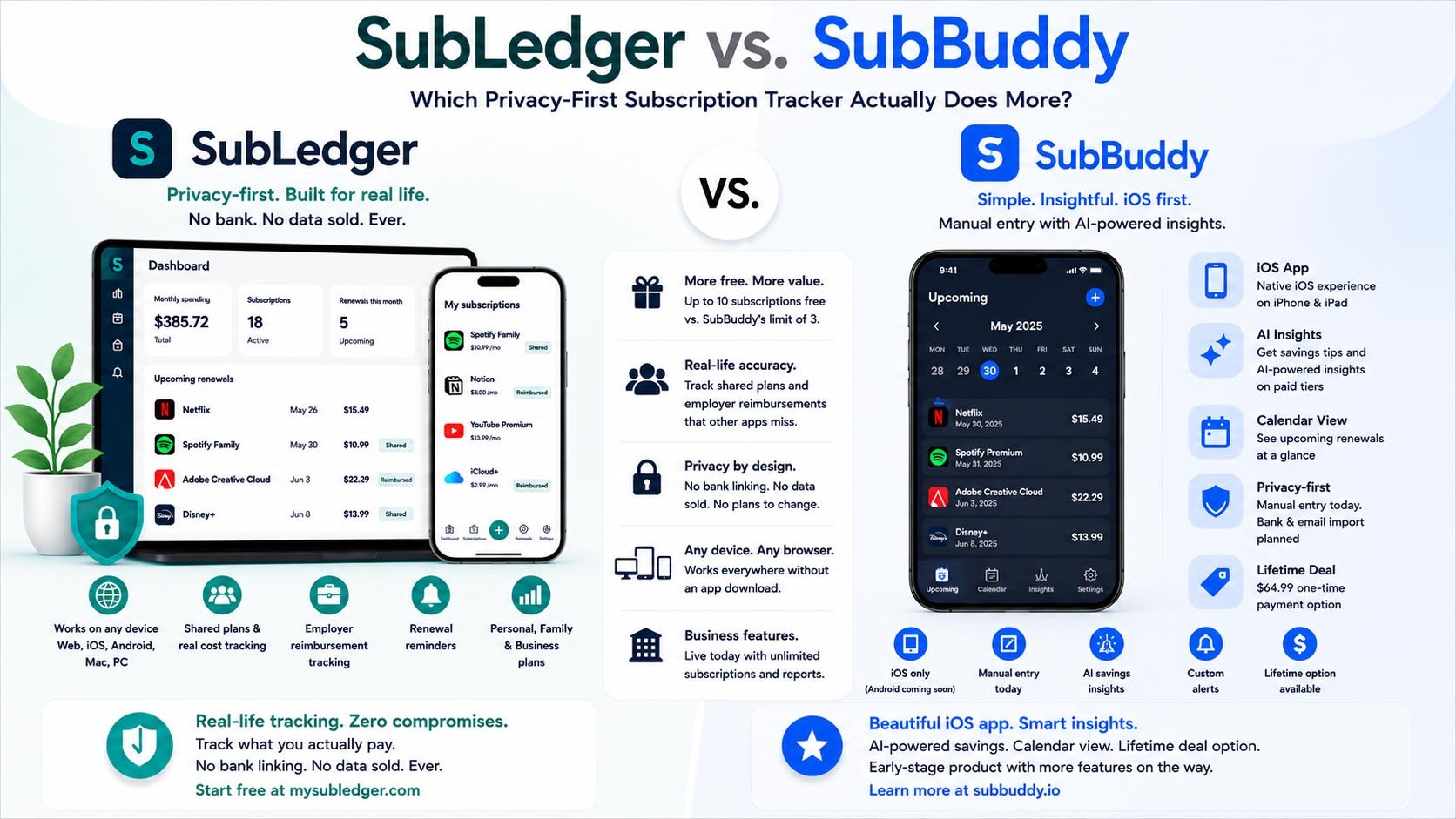
TL;DR
- Both SubLedger and SubBuddy are privacy-first manual subscription trackers that don’t currently require bank access.
- SubLedger’s free tier supports 10 subscriptions vs. SubBuddy’s 3 — a significant practical difference.
- SubLedger uniquely tracks shared plans and employer reimbursements; SubBuddy does not.
- SubBuddy’s roadmap includes future bank and email import; SubLedger has no plans to add bank linking.
- SubBuddy offers a $64.99 lifetime deal; SubLedger offers a more generous free tier with monthly paid plans.
What Is SubBuddy?
SubBuddy is a subscription tracking app built around manual entry, renewal reminders, and a privacy-first stance. It offers a calendar view, basic analytics, and AI-driven savings insights on paid tiers. SubBuddy is available as an iOS app, with Android listed as coming soon.
Like SubLedger, SubBuddy does not currently require bank account access — though their own FAQ notes that bank and email import are planned for future releases. Their paid model offers a monthly plan and a one-time lifetime deal, with a notably thin free tier that caps at just 3 subscriptions.
Subbuddy Pricing
| Plan | Price | Subscriptions | Key Features |
|---|---|---|---|
| Free | $0 | Up to 3 | Calendar view, basic monthly total |
| Monthly | $4.99/mo. | Unlimited | 1-month free trial, AI insights, advanced analytics, custom alerts |
| Lifetime | $64.99 one-time | Unlimited | Everything on monthly, all future updates, 30-day money-back guarantee |
What Is SubLedger?
SubLedger is a privacy-first subscription tracker built around one principle: you should be able to manage every subscription you pay for without sharing your bank account with anyone. No bank linking. No data sold. Ever.
SubLedger goes further than most trackers by accounting for how subscriptions actually work in real life — including plans shared with family members and tools reimbursed by employers. Paid plans are processed through Stripe. That’s the only financial connection SubLedger makes.
SubLedger Pricing
| Plan | Price | Subscriptions | Key Features |
|---|---|---|---|
| Free or Pay What You Can | $0/mo. | Up to 10 | Renewal reminders, dashboard & summaries |
| Personal | $10/mo. | Up to 20 | All Free features, employer reimbursement tracking |
| Family | $20/mo. | Up to 50 | All Personal features, assign subscriptions to family members, shared cost tracking |
| Business | $50/mo. | Unlimited | All Family features, custom categories, bookkeeper access, downloadable reports |
Head-to-Head: The Key Differences
1. Free Tier Generosity
This is the most immediate practical difference. SubBuddy’s free tier caps at 3 subscriptions. For most people, that’s not enough to get a real picture of their recurring spend — the average American has more than 8 active subscriptions. You’ll hit the limit before you’ve finished entering your streaming services.
SubLedger’s free tier supports up to 10 subscriptions with full renewal reminders, category tracking, shared plan flags, and employer reimbursement flags included. For most individuals, that’s enough to track everything without ever paying a cent.
2. Shared Plans and Employer Reimbursements
SubBuddy tracks subscriptions at their full listed price. There is no way to flag that you split a streaming service with family members, or that your employer covers your project management tool. What you enter is what you see — which can significantly overstate your real personal subscription spend.
SubLedger includes a built-in “Shared with others” toggle and an “Employer reimbursement” flag on every subscription entry. These two features alone make SubLedger’s cost tracking materially more accurate for anyone with a shared household or a remote job.
3. Bank Linking — Now and in the Future
Currently, neither SubBuddy nor SubLedger requires bank account access. Both use manual entry. On this point they are aligned — and both are stronger than bank-linked competitors like Rocket Money, Hiatus, and Trim for users who value financial privacy.
The difference is in the roadmap. SubBuddy’s own FAQ states that bank and email import are planned upcoming features. Once that arrives, SubBuddy’s privacy positioning changes. SubLedger has no plans to add bank linking — not because it hasn’t been considered, but because the product was intentionally built to work without it.
4. Data Privacy
SubBuddy states they do not sell user data, and their payments are processed through Stripe. Their privacy policy is relatively sparse — the contact email listed is a Gmail address, which signals a very early-stage independent product.
SubLedger does not sell your data. Payments are processed through Stripe. No bank account data is collected — not now, not in a future update. There is no roadmap item that changes this.
5. Pricing Model
SubBuddy’s most interesting pricing option is the lifetime deal at $64.99 — a one-time payment for permanent access. For users who are confident they’ll use a subscription tracker long-term, this can work out cheaper than a monthly plan.
SubLedger’s pricing starts free with a generous 10-subscription limit, and paid tiers are monthly. The tradeoff is flexibility vs. upfront cost. SubLedger lets you start with no commitment, while SubBuddy’s lifetime deal rewards users who are ready to commit.
Feature Comparison at a Glance
| Feature | SubLedger | SubBuddy |
|---|---|---|
| No bank account required | ✅ Yes — by design | ✅ Yes (for now) |
| Bank linking planned | ❌ No plans | ⚠️ Listed on roadmap |
| Data selling policy | ✅ Never sells data | ✅ States no data selling |
| Free tier subscriptions | ✅ Up to 10 | ⚠️ Only 3 |
| Shared plan tracking | ✅ Built-in toggle | ❌ Not available |
| Employer reimbursement flag | ✅ Built-in toggle | ❌ Not available |
| Renewal reminders | ✅ Yes | ✅ Yes |
| AI insights | ❌ No | ✅ Paid tiers |
| Calendar view | ❌ No | ✅ Yes |
| Lifetime pricing option | ❌ No | ✅ $64.99 one-time |
| iOS app | ⚠️ Web (mobile-responsive) | ✅ Native iOS app |
| Android | ⚠️ Web (mobile-responsive) | ❌ Coming soon |
Which Tool Is Right for You?
Choose SubLedger if you:
- Want to track more than 3 subscriptions for free
- Share subscription plans with family members
- Have employer-reimbursed tools you want to track separately
- Want a tracker that will never add bank linking
- Want web access across any device without a native app download
- Prefer a monthly subscription model over a lump-sum payment
Choose SubBuddy if you:
- Want a native iOS app experience
- Are comfortable paying $64.99 upfront for a lifetime deal
- Want AI-powered insights and savings recommendations
- Only have a small number of subscriptions to track
- Want a visual calendar view of upcoming renewals
Sources
The following sources were used in the research and preparation of this article. SubLedger’s payment processing is handled exclusively through Stripe (stripe.com). SubLedger does not link to or store bank account information.
- SubBuddy Pricing Page: https://subbuddy.io/en#pricing
- SubBuddy Privacy Policy: https://subbuddy.io/en/privacy-policy
- SubBuddy FAQ (bank/email import roadmap reference): https://subbuddy.io/en#faq
SubLedger’s free tier tracks up to 10 subscriptions
More than three times SubBuddy’s free limit with renewal reminders, shared plan tracking, and employer reimbursement flags included. No bank account. No data sold. No plans to change either of those things.
TRY SUBVLEDGER FREEFAQ
Does SubBuddy sell your data?
SubBuddy states in their privacy policy that they only share data with user consent, to comply with laws, or to provide services. They process payments through Stripe. SubLedger also does not sell data and similarly uses Stripe for payment processing only.
Will SubBuddy ever require a bank account?
SubBuddy’s FAQ explicitly mentions bank and email import as planned upcoming features. Once added, their current no-bank-linking privacy posture will change. SubLedger has no plans to add bank linking.
Is SubBuddy’s lifetime deal worth it?
If you’re confident you’ll use a subscription tracker for more than 13 months, the $64.99 lifetime deal works out cheaper than $4.99/month. The consideration is that it’s an early-stage product and the long-term viability of any independent app is never guaranteed.
Why does SubLedger’s free tier allow 10 subscriptions vs. SubBuddy’s 3?
SubLedger was designed so that most individuals can use the free tier indefinitely without hitting the limit. The average person has 8 active subscriptions. SubLedger’s free tier covers that. SubBuddy’s 3-subscription cap is more of a trial experience than a functional free product.