

Gen Z Gets It: Why Not Everything Needs AI
TL;DR
- Gen Z’s excitement about AI is falling fast, with growing concerns about job loss, privacy, surveillance, and the real-world impact of automation.
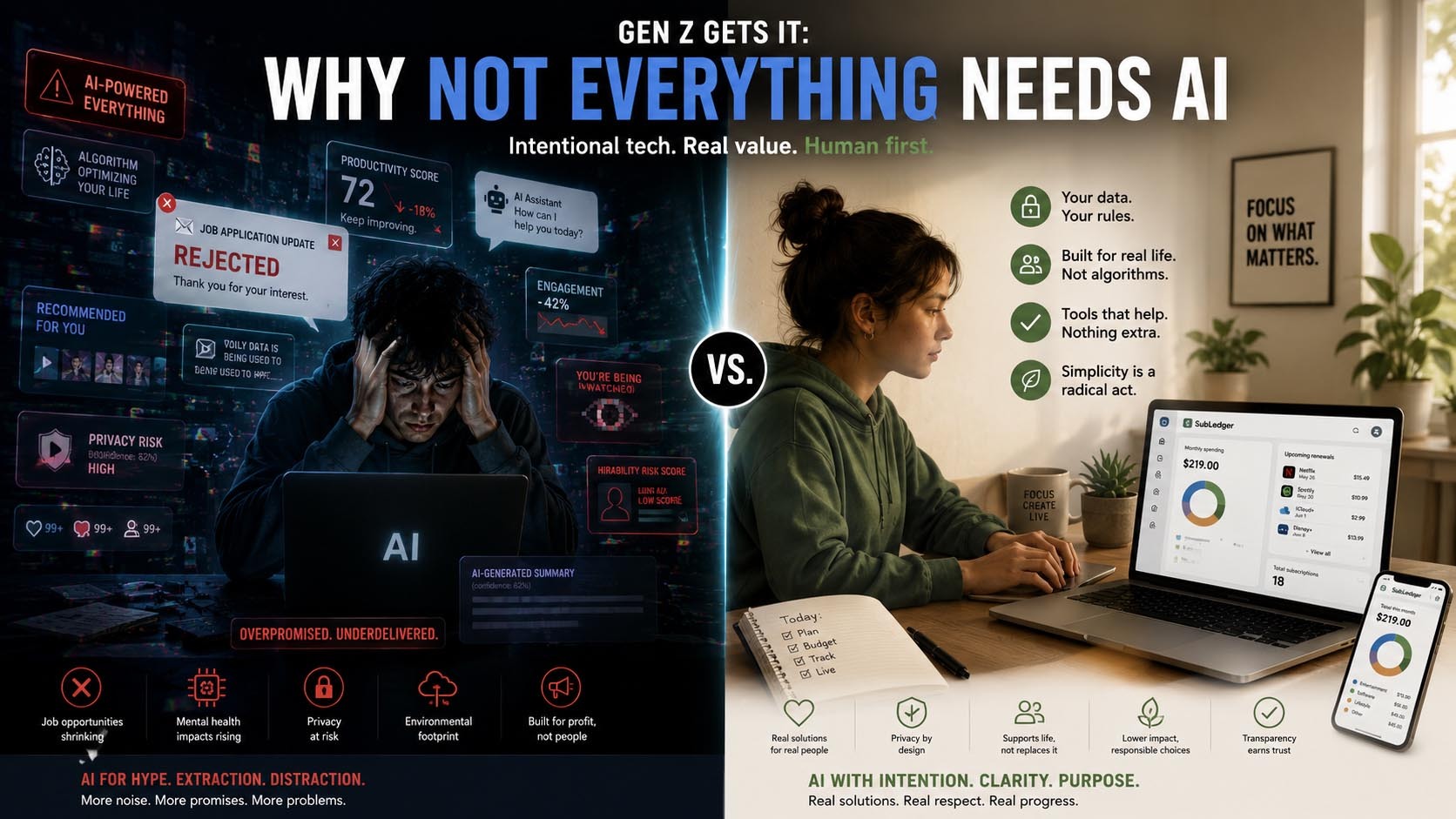
- Young workers aren’t rejecting technology — they’re rejecting products that use AI unnecessarily or treat people and personal data as expendable.
- The era of adding “AI-powered” to every product as a selling point is losing its appeal, especially among younger users who have grown skeptical of tech industry promises.
- SubLedger intentionally chose a simpler, privacy-first approach: solving a real problem without requiring AI, bank access, email scanning, or invasive data collection.
The tech industry often says Gen Z grew up with smartphones and constant algorithms. They're seen as digital natives and early adopters, expected to embrace AI more quickly and eagerly than any previous generation. In this view, Gen Z is the future, and that future is all about artificial intelligence.
The data shows otherwise.
A 2026 Gallup survey with the Walton Family Foundation and GSV Ventures found that Gen Z's excitement about AI dropped by 14 points to 22%. Hopefulness fell by nine points to 18%, while anger rose by nine points to 31%. Even daily AI users feel less excited and hopeful than last year, down 18 and 11 points. The more Gen Z uses AI, the worse they feel about it.
The Numbers Don't Lie
Gen Z hasn't stopped using AI. The share using it daily or weekly ticked up only slightly, from 47% to 51%, suggesting use is "plateauing," according to Gallup. They're not abandoning the tools. They're simply no longer impressed by them.
Curiosity is still the most commonly felt emotion toward AI among Gen Z, but it's closely followed by anxiety and anger. The lowest-ranked responses, by a significant margin, are excitement and hope.
What changed? A year of real-world experience. A year of watching AI get inserted into every product, every workflow, every hiring process, whether it made things better or not. A year of being told that AI would unlock opportunity, while watching those opportunities disappear.
Nearly half of Gen Z respondents said the risk of AI outweighs the benefits in the workforce. Only 37% believed it would help them find accurate information, down from 43% the prior year, and only 31% believed it would help them come up with new ideas, compared to 42% in 2025.
These aren't the feelings of people who don't understand the technology. These are the sentiments of people who understand it all too well.
Why They're Angry
Gen Z's frustration with AI is economic, and it's personal. And it's entirely justified.
The unemployment rate for recent college graduates hit 5.7% in the fourth quarter of 2025, above the national rate — a reversal that almost never happens. Underemployment for recent grads sits at 42.5%, the highest since 2020.
The mechanism behind those numbers matters. This isn't primarily a story of mass AI-driven layoffs. The story is more one of quiet erasure. At companies that have adopted AI, junior hiring fell nearly 8% within six quarters — not through firings, but through a freeze on new positions.
An entry-level job isn’t just a paycheck. It’s where young workers learn to think, build judgment, and develop the experience that carries them through a career. When those jobs disappear, the damage compounds across decades.
And the institutions that were supposed to prepare Gen Z for this moment largely failed them. More than half of college students say their school either discourages or outright bans the use of AI, yet 63% of faculty believe their 2025 graduates were not very prepared to use AI in the workplace. Schools banned the tools their students needed to learn. Employers demanded skills they were never taught. And the government, as Fortune put it, has been somewhere else entirely.
Forty-four percent of Gen Z workers admit to actively sabotaging their company's AI rollout, compared with 29% of workers overall. That's not technophobia. That's workers who feel unprotected, acting accordingly.
The Trust Problem
Beyond jobs, there's a deeper issue: Gen Z doesn't trust that AI delivers what it promises.
They've grown up watching social media platforms promise connection and deliver anxiety. They've seen data breaches, algorithmic manipulation, and products built to extract value from users rather than provide it. They're pattern-matching, and the pattern they're seeing with AI looks familiar.
As AI use increased among Gen Z, so did reports of its adverse impact on mental health, the job market, and trust in government and institutions. The technology isn't neutral to them. It represents everything else that's been done to them in the name of innovation and progress.
And they're asking: does this tool really make my life better? Or does it just make someone else's product more fundable?
The Case for Intentional AI Use
Gen Z's skepticism is really telling us that reflexive AI adoption is over. The era of slapping "AI-powered" on a product and watching users celebrate is done, at least with the generation that's about to become the dominant consumer and workforce demographic.
That doesn't mean AI has no place. We need to reevaluate where AI belongs.
The environmental footprint of large AI models is real and still being fully measured. The job displacement effects are real and accelerating. The data privacy implications of AI-powered products, including where user data gets processed, stored, and sometimes sold, are real and largely unaddressed. Gen Z is thinking about all of this, even if they can't always articulate it. They feel it.
They respond positively to tools built with intention and are transparent about what they do and don't do with your data. They gravitate toward tools that solve a specific problem, without requiring you to hand over your privacy as the price of admission.
That's not a niche preference. It’s increasingly mainstream, especially among the generation that's going to define what mainstream looks like for the next two decades.
What This Means for Builders
If you're building a product right now, the temptation to add AI features is enormous. Investors ask about it. Press covers it. Product Hunt rewards it. The conventional wisdom says AI-powered is better than not.
But conventional wisdom is written by the people who built the last era of tech. That’s the same people who gave us surveillance capitalism, algorithmic feeds optimized for outrage, and data broker ecosystems that treat personal information as a commodity. Gen Z watched that era unfold in real time. They're not interested in repeating it.
The builders who earn Gen Z's trust will be the ones who are open about their choices, use AI when it genuinely makes the product better, and skip it when it doesn't. They’ll respect those who treat user data as something to protect, not monetize and build tools that do exactly what they say and nothing more.
Simplicity, at the current moment, is a radical act.
Why SubLedger Chose a Different Path
SubLedger was built to solve a problem: people don't know what their subscriptions are really costing them and are often surprised by subscriptions they’ve forgotten. The average American spends $219 a month on subscriptions. Most people would guess they spend much less. That gap between what you think you're spending and what you're actually spending is where money disappears every single day.
Solving that problem doesn't require AI. It requires a clean interface, smart reminders, and the ability to account for the real complexity of how people share and split costs. That's what SubLedger does.
We made a deliberate choice not to incorporate AI into the product, not because we don't understand the technology. SubLedger was built with AI tools, and our team uses AI in our work when appropriate. But we asked the question Gen Z is increasingly asking: does this tool actually need AI? And the answer was no.
There's also a bigger reason. The full environmental and social cost of AI is still being calculated. Until we better understand the scope of AI impact on energy consumption, water usage, and job displacement, we think builders have a responsibility to use AI sparingly and intentionally.
That philosophy isn't a limitation. It's a commitment to building something trustworthy.
Gen Z didn't turn its back on AI out of ignorance. They turned their back on a version of AI that treats their jobs, their data, and their futures as acceptable collateral damage in the pursuit of the next funding round.
Their skepticism is exactly the kind of critical thinking we should want from the generation inheriting the world we're building. They're asking the right questions. They're demanding integrity from the tools they use and the companies behind them.
The products that will earn their trust aren't the ones with the most impressive AI features. They're the ones built with genuine respect for what users actually need and the understanding that, sometimes, simpler is better.
Sources
- Gallup, Walton Family Foundation & GSV Ventures. "Gen Z's AI Adoption Steady, but Skepticism Climbs." April 9, 2026. https://news.gallup.com/poll/708224/gen-adoption-steady-skepticism-climbs.aspx
- Lichtenberg, Nick. "Gen Z Turning Its Back on AI Isn't Irrational — It's a Verdict on Everyone Who Failed Them." Fortune, April 16, 2026. https://fortune.com/2026/04/16/why-does-gen-z-distrust-ai-anxiety-failures-college-work-government/
- Gizmodo. "Gen Z's Use of AI Is Plateauing and It's Feeling Less Hopeful About the Tech." April 9, 2026. https://gizmodo.com/gen-zs-use-of-ai-is-plateauing-and-its-feeling-less-hopeful-about-the-tech-2000744463
- Semafor. "American Gen Zers Grow More Uneasy About AI." April 9, 2026. https://www.semafor.com/article/04/09/2026/gen-zers-grow-more-uneasy-about-ai
- Axios. "Gen Z's Fading AI Hype." April 9, 2026. https://www.axios.com/2026/04/09/ai-gen-z-polling-gallup
- The 74. "Gen Z Increasingly Skeptical of — And Angry About — Artificial Intelligence." April 9, 2026. https://www.the74million.org/article/gen-z-increasingly-skeptical-of-and-angry-about-artificial-intelligence/
- Lira, Benjamin, Folk, Dunigan, Ungar, Lyle, and Duckworth, Angela L. "How Gen Z Uses Gen AI — and Why It Worries Them." Harvard Business Review, January 28, 2026. https://hbr.org/2026/01/how-gen-z-uses-gen-ai-and-why-it-worries-them
- Boser, Ulrich. "AI Adoption Rising: So Why Is Gen Z Trust Declining?" Forbes, May 4, 2026. https://www.forbes.com/sites/ulrichboser/2026/05/04/ai-adoption-rising-so-why-is-gen-z-trust-declining/
Try SubLedger Free
Get started free. Track up to 10 subscriptions with renewal reminders and real cost tracking — including shared plans and employer reimbursements. No bank account. No data sold.
START FOR FREE